
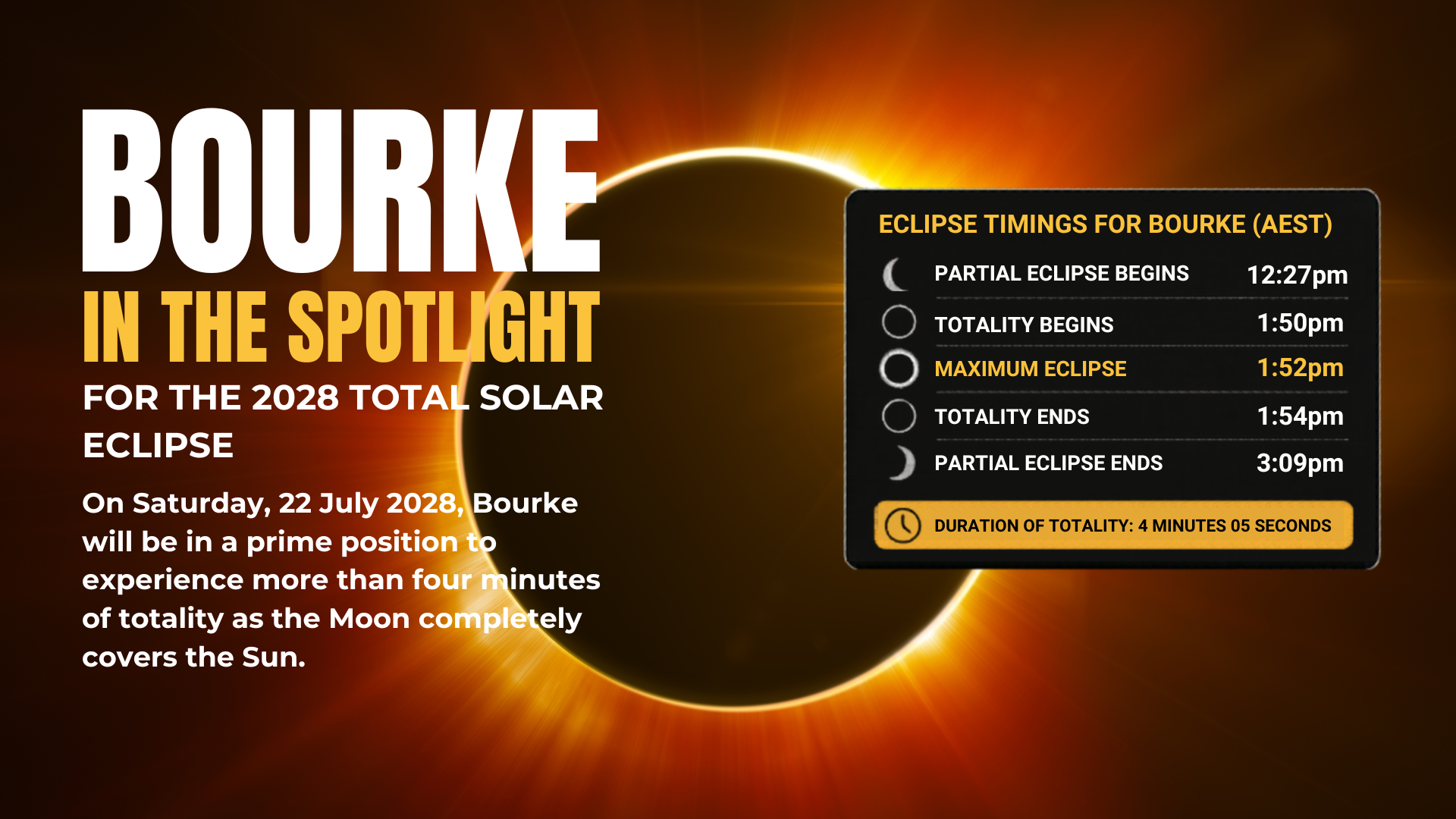
Bourke is being tipped as one of Australia’s premier inland viewing locations for the rare total solar eclipse set to cross the country on Saturday, 22 July 2028.
The once-in-a-generation event will plunge parts of Australia into daytime darkness as the Moon completely passes in front of the Sun, with Bourke sitting directly inside the eclipse’s path of totality — the zone where the full eclipse can be experienced.
According to current astronomical calculations, viewers in Bourke are expected to witness more than four minutes of totality, with the peak of the eclipse forecast around 1:52pm local time.
The eclipse will begin as a partial eclipse shortly after midday before the sky dramatically darkens during totality, creating one of nature’s most spectacular sights.
Astronomers and eclipse tourism groups are already identifying inland New South Wales as one of the best regions for viewing conditions due to its typically drier winter climate and lower cloud risk compared with many coastal areas.
That puts Bourke in a particularly strong position.
Located close to the centreline of the eclipse path, the town is expected to attract interest from photographers, astronomy enthusiasts, scientists, travellers and media organisations from both Australia and overseas.
The eclipse path will stretch diagonally across Australia — entering through Western Australia’s Kimberley region before crossing the Northern Territory, southwest Queensland, northwestern NSW, Sydney and then heading toward New Zealand.
While Sydney is also expected to experience totality, regional centres like Bourke may become increasingly attractive to visitors looking for clearer skies, less congestion and a unique outback viewing experience.
Tourism operators and accommodation providers across the region could potentially benefit from a major influx of visitors in the lead-up to the event.
Industry observers say accommodation demand for major eclipses often begins years in advance, with travellers frequently booking camping sites, motels, caravan parks and tours well ahead of time.
The eclipse also presents opportunities for the region to showcase local tourism attractions, Indigenous cultural knowledge, outback hospitality and community events tied to the occasion.
Potential ideas already being discussed around Australia for eclipse destinations include astronomy festivals, educational programs, public viewing sites, night sky experiences, cultural storytelling and live broadcasts.
Current eclipse timing estimates for Bourke indicate:
- Partial eclipse begins: approximately 12:27pm
- Totality begins: approximately 1:50pm
- Maximum eclipse: approximately 1:52pm
- Totality ends: approximately 1:54pm
- Partial eclipse ends: approximately 3:09pm
A total solar eclipse occurs when the Moon passes perfectly between the Earth and the Sun, temporarily blocking the Sun’s light and turning day into twilight for several minutes.
The 2028 eclipse is already being described by astronomy groups as one of Australia’s biggest skywatching opportunities in decades, with some experts predicting it could become one of the nation’s largest astronomy tourism events ever.
For Bourke and surrounding communities, it could place the region firmly in the international spotlight.